
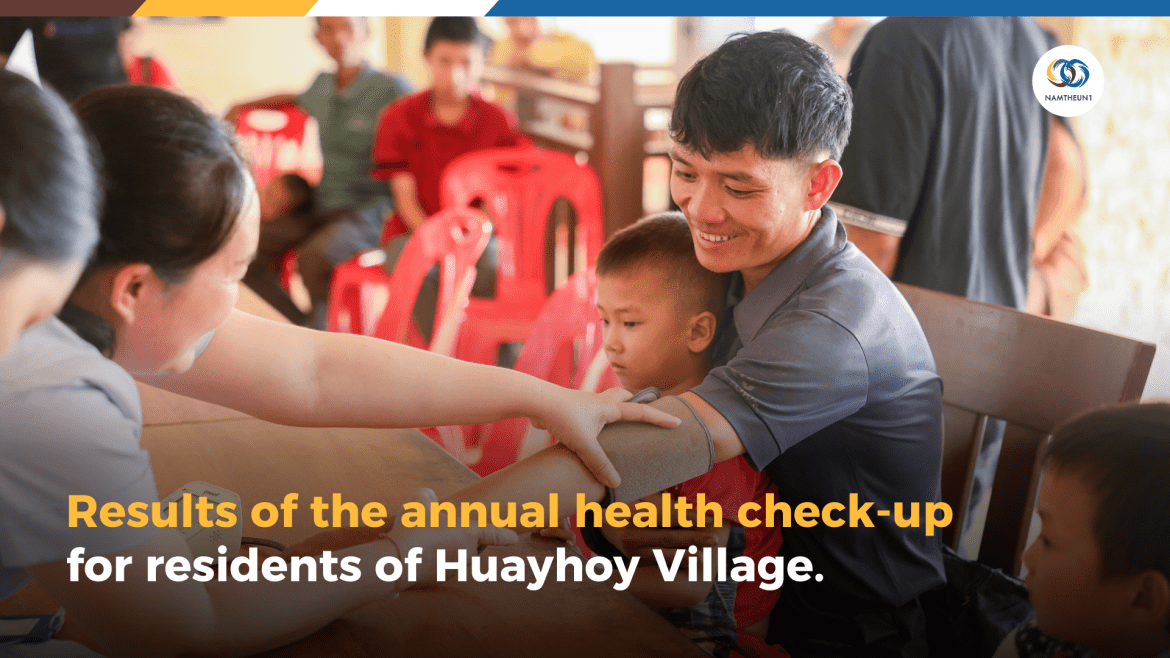
Overview of the Annual Health Checkup 2025 for Huayhoy Residents
In mid-December 2025, Nam Theun 1 Power Company Limited (NT1PC) organized its annual health checkup for residents of Huayhoy Resettlement Village, Viengthong District, Bolikhamxay Province. The event was conducted by medical staff from Huayhoy Health Center and Viengthong District Hospital.
During the event, medical staff, together with NT1PC’s Senior Health and Education Officer, set up a station to collect residents’ medical histories. This included information on health-related behaviors, initial health measurements, and past illness history. Residents were then guided to clinical examinations (observation, palpation, auscultation) and additional tests (blood tests, sputum tests, echo tests) to help identify diseases and provide appropriate treatment recommendations.
Out of 2,058 residents targeted for the health checkup, only 955 attended, representing 46% of the planned participants. Attendance has decreased over the years, highlighting a challenge for NT1PC and local authorities to develop new strategies to encourage greater participation in future checkups.
Health Checkup Results
On 14 January 2026, the Viengthong District Health Office held its annual 2025 implementation review meeting and presented the results of the Huayhoy Health Checkup. Key findings and recommendations are summarized below:
Villagers’ Health Behavior
Since the resettlement in 2019, overall health behaviors have improved. In 2025:
- 99% of residents consumed pasteurized water (compared to 8.9% in 2019)
- 87% regularly consumed cooked food
- However, 29.8% still consumed raw meat (cow or buffalo), reflecting local dietary traditions
Illness in the Past Year
Among the 955 residents who attended the checkup, 224 reported experiencing illness in the past year. Of these, 99.3% received treatment from health service facilities (both governmental and private). The remaining residents either purchased medicine from pharmacies, used traditional medicine, or sought spiritual remedies.
During the December checkup, 498 residents (52%) were found to have an illness. Seventy different conditions were identified, with the ten most common being:
- Neuralgia
- Pharyngitis
- Gastritis
- Hypertension (HTN)
- Common cold
- Vertigo
- Grippe (Influenza)
- Amygdalitis (Tonsillitis)
- Migraine
- Anemia
Most residents presenting for the checkup reported experiencing illness within the past 7 to 30 days. Residents with no recent health complaints were less likely to attend.
Deaths in the Past Year
Seventeen villagers passed away, ranging from 6 to 93 years old. Causes of death included:
- High blood pressure: 4 people
- Accidents: 3 people
- Diabetes: 2 people
- Cervical cancer, tuberculosis, kidney failure, fatigue, and fever: 1 person each
Reproductive-Aged Women (15–49 years)
A total of 281 women attended the checkup. Of these, 232 had experienced pregnancy, with a total of 669 pregnancies, resulting in 626 births and 597 surviving infants in 2025. Among last-born children born before 2019 (prior to resettlement), 36% were delivered with medical assistance. By 2025—after six years of resettlement—this proportion had increased to 81%.
Family planning usage increased from 54.4% in 2019 to 71% in 2025. However, only 44% of women were aware of sexually transmitted diseases (unchanged from 2019), and 61% did not know about protective methods.
Children Under 5 (CU5)
Among the 124 children under five who received a checkup:
- 85% were fully vaccinated according to the national schedule
- 7.3% were underweight (down from 19.6% in 2019)
- 21.8% experienced stunting (down from 35.8% in 2019)
Summary and Recommendations
Overall, the health condition of Huayhoy residents has improved since resettlement in 2019. Improvements were noted in health-related behaviors, access to health services, and maternal and child health. However, the proportion of residents experiencing illness in 2025 increased, and participation in health checkups has declined.
Recommendations for future action:
- Household surveys should be conducted through visits to every household to ensure full coverage. The questionnaire should include essential information such as access to clean water, latrine use, and waste management practices.
- Strengthen the quality of health services to ensure medical staff can accurately identify illnesses and provide clear, actionable self-care recommendations.
- Build trust with community members to encourage greater utilization of health services.
- Provide training for health staff on delivering health awareness sessions and conducting health checkups effectively at the village level.
- Increase the frequency of health awareness sessions for villagers, focusing on topics that are not well understood, to improve health practices and outcomes.
NT1PC remains committed to implementing the Livelihood Restoration Plan over the next four years, aiming to strengthen local health services and promote the health and prosperity of Huayhoy residents and surrounding communities.