
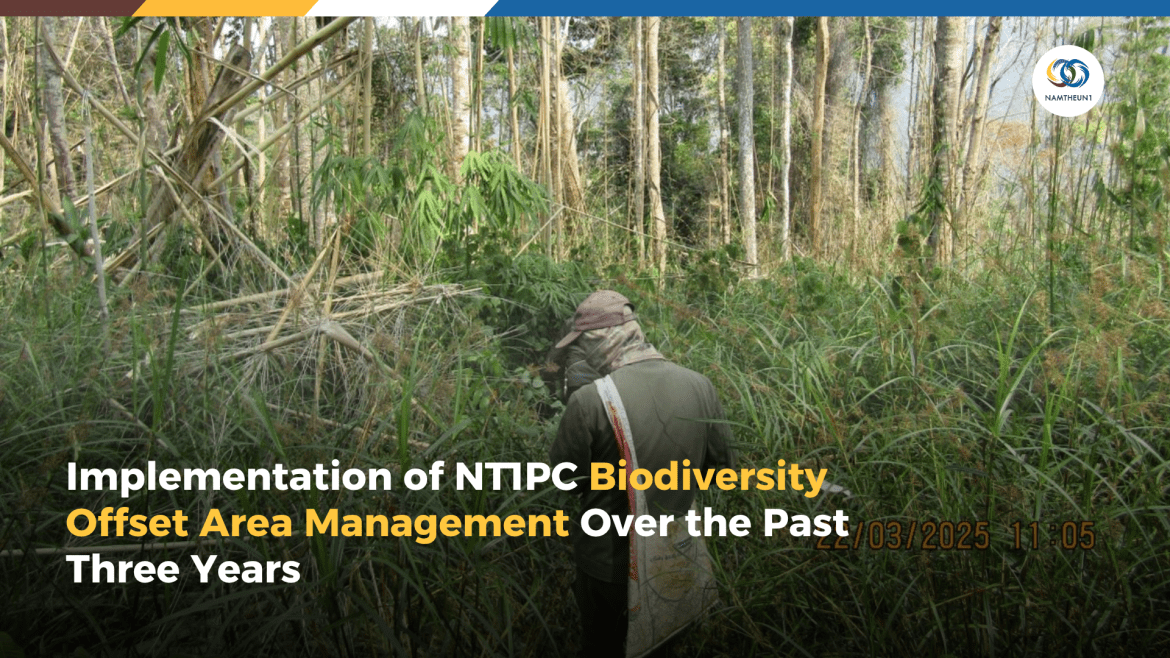
The operation of hydropower dams plays a crucial role in stimulating economic growth and generating income for the nation. However, the construction of large dams inevitably impacts the environment. To mitigate these environmental effects, and in accordance with the Concession Agreement between Nam Theun 1 Power Company Limited (NT1PC) and the Government of Laos, a biodiversity offset area has been designated to help restore natural resources. This area aims to conserve and enhance the diversity of aquatic and terrestrial wildlife, forest ecosystems, non-timber forest products, water resources, and overall biodiversity.
The Lao government designated the Huay Pa Song–Huay Hoy area, part of the Pakkading National Reserved Forest, as the Nam Theun 1 Biodiversity Offset Area. Covering 28,600 hectares across Pakkading, Khamkerd, and Viengthong districts, NT1PC is responsible for managing this area throughout the 27-year lifespan of the hydropower project.
To implement this work, NT1PC partnered with the Wildlife Conservation Association (WCA), a biodiversity management expert organization, assigning them responsibility for developing sub-plans, handbooks, and leading the implementation. This effort officially began in 2022, the same year NT1PC signed its Power Purchase Agreement.
On June 20, 2025, NT1PC, in collaboration with WCA, held a meeting to review and summarize the progress of the Biodiversity Offset Area Management implementation from May 2022 to March 2025. The meeting was chaired by Mr. Sonexay Phommavong, Deputy Head of the Bolikhamxay Provincial Agriculture and Forestry Office. Attendees included representatives from various relevant agencies: the Department of Forestry under the Ministry of Agriculture and Forestry; Bolikhamxay Provincial Agriculture and Forestry Office; the Provincial National Park Management Division; the Provincial Forest Inspection Division; district administrators and heads of the Agriculture and Forestry Offices from Pakkading, Khamkerd, and Viengthong districts; district military commanders; village authorities from six targeted villages; the Wildlife Conservation Association (WCA); the Wildlife Conservation Society (WCS); and the NT1PC team led by Mr. Bounnhang Phengsouvanh, Government Relations Advisor.
During the meeting, participants listened to a report on the three-year implementation of the program. This was followed by discussions to evaluate outcomes and provide feedback for future improvements. Over the past three years, WCA has followed its master plan, which includes four key components:
Element 1: Establishment of the Huay Pa Song–Huay Hoy Biodiversity Conservation System
Focused on developing a patrolling strategy and establishing legal procedures for handling offenders.
Element 2: Monitoring System Development
Included creating handbooks, legal frameworks, data collection tools, and systems to analyze biodiversity and law enforcement performance.
Element 3: Biodiversity Management System
Implemented in partnership with the Nam Kading National Park Division and local authorities, this component emphasized planning, reporting, and sharing lessons learned.
Element 4: Community Engagement in Biodiversity Management
Included financial support to target villages, establishing village conservation teams to build local ownership, and conducting awareness-raising activities in surrounding communities.
Despite strong implementation, the area still faces persistent threats such as illegal logging, wildlife poaching, and unsustainable harvesting of non-timber forest products. To address these challenges, attendees proposed several recommendations to improve effectiveness, including:
- Establishing more checkpoints along access roads to protected areas
- Increasing the frequency of patrols in high-risk areas
- Providing refresher legal training and updated guidelines for patrol teams
- Conducting awareness activities for local government staff
- Considering welfare support for patrol teams
However, implementing many of these suggestions requires careful consideration of available budgets and the involvement of relevant partners. Continued collaboration and support will be essential to ensuring the success of biodiversity conservation efforts in the years ahead.